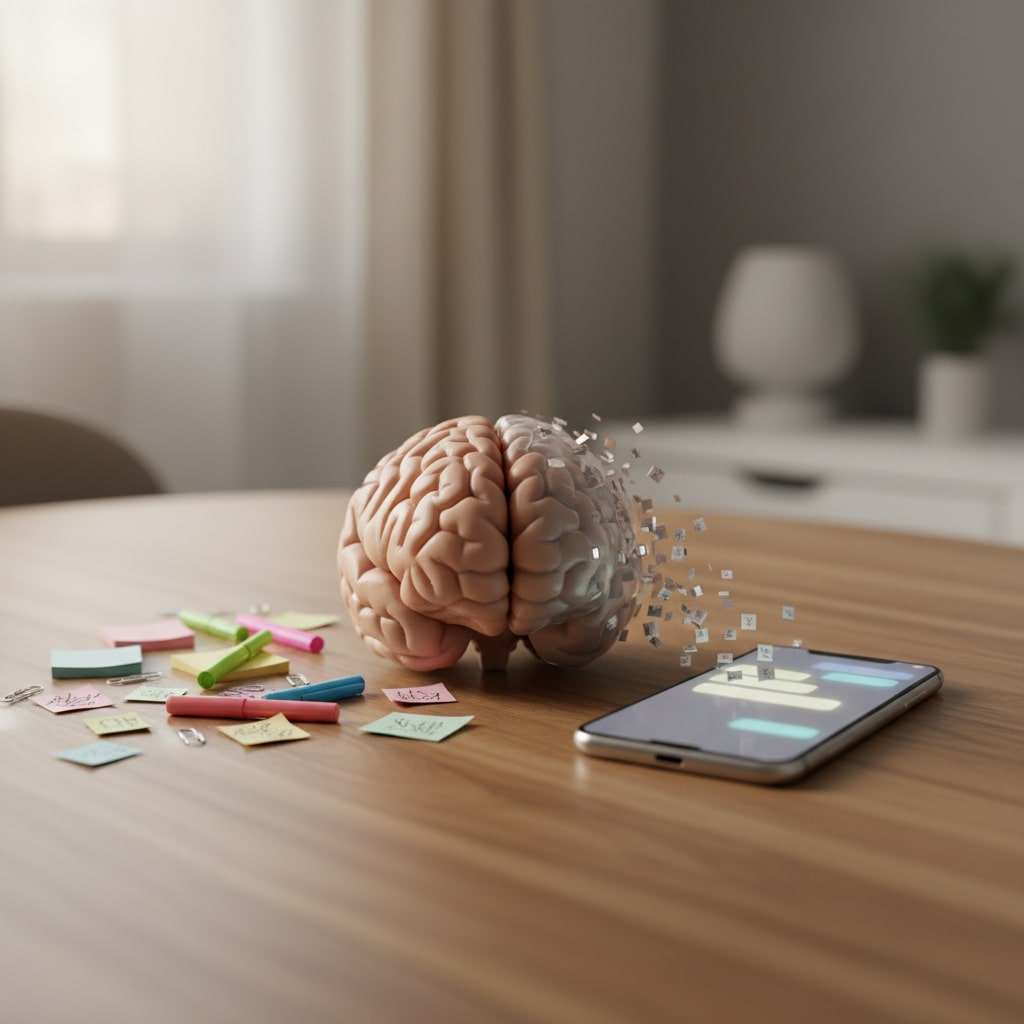
If you’ve ever stared at a blank page and thought, “I’ll just get AI to start this for me,” you’re exactly who this story is about. The BBC’s piece, “Are these AI prompts damaging your thinking skills?”, digs into a question that matters to anyone juggling work, family and a busy life: when we offload thinking to AI, what happens to our own brain in the long run?
Researchers at MIT recently watched people’s brain activity while they wrote essays, sometimes with help from ChatGPT. Using EEG to track their brain signals, they found that those who leaned on AI showed less activation in areas linked to cognitive processing and, interestingly, struggled more to recall what they’d written.
In other words, the essay might have looked better on the page, but it didn’t seem to “stick” in their minds. As one expert, Prof Wayne Holmes from UCL, puts it: “Their outputs are better but actually their learning is worse.”
That’s the standout tension in this article: AI can genuinely boost productivity and polish, but there’s a real risk of “cognitive atrophy” if we let it think for us too often. Similar concerns show up in studies of white‑collar workers using AI for problem‑solving, and even in radiology, where AI support improved some clinicians’ performance but made others worse. The worry is not that AI exists, but that we might stop flexing our own problem‑solving muscles.
For women over 35 who are often the decision‑makers at home and at work, this is especially relevant. AI tools can feel like a lifesaver: helping you condense long documents, refine emails, or brainstorm ideas after a long day.
The article, though, suggests a subtle but powerful reframe: use AI as a tutor, not a ghostwriter. Jayna Devani from OpenAI describes the ideal as a back‑and‑forth, where you ask questions, break down problems, and stay actively engaged instead of handing over the whole task.
Dr Alexandra Tomescu from Oxford University Press offers a more balanced, hopeful take. She notes that while some students feel AI makes it “too easy” to do the work, nine in ten say it’s helped them with at least one skill, from problem‑solving to creativity. The key is guidance, awareness and intention.
Why this matters now: AI isn’t going away, and tools like ChatGPT are already woven into everyday life. The real opportunity is to make them partners in our thinking, not replacements for it. That means pausing to ask: am I learning, or just getting through this task faster?
If you’re curious about how AI may be shaping your own thinking, and how to keep your critical skills sharp while still taking advantage of smart tools, the full BBC article is well worth a read.